


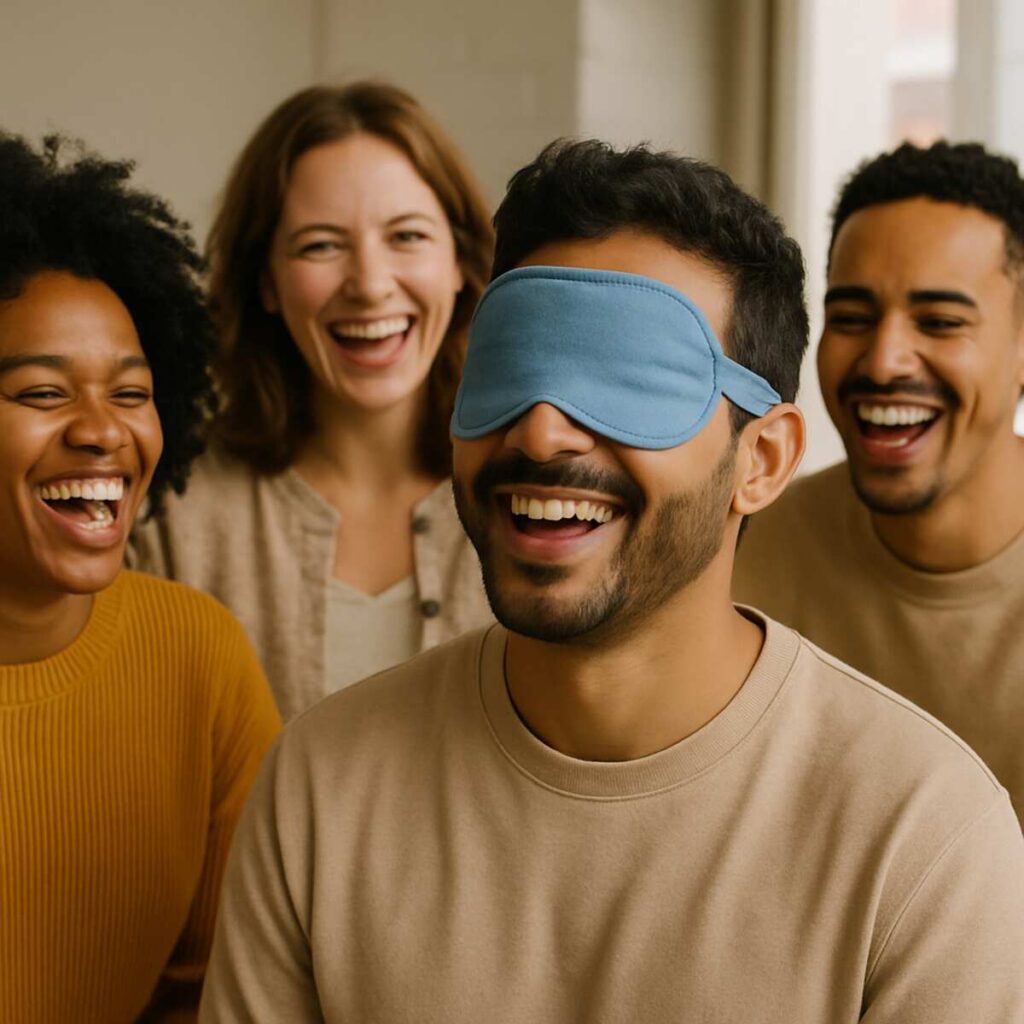
Remember the dizzying, laughter-filled chaos of trying to pin a paper tail on a cardboard donkey at a childhood birthday party? Most of us leave these simple activities behind as we grow up, trading them for the constant visual stimulation of modern screens and smartphones. Yet, stepping away from this visual overload can actually wake up our tired brains in surprising ways. Engaging in intentional blindfold games offers a refreshing break from our screen-heavy routines, instantly transforming a standard afternoon into an adventure in deep listening and connection. To find more, check on tenyom189
Imagine navigating your own living room using nothing but the sound of a friend’s voice or the texture of the carpet underfoot. When we temporarily remove our sense of sight, a fascinating biological process called sensory compensation kicks in to fill the gaps. According to child development experts, taking visual input away forces our other senses to work much harder. Almost immediately, our ears and skin become “high-definition” receptors, catching subtle echoes and sudden shifts in air movement that we usually ignore.
Beyond waking up dormant senses, wearing a mask acts as a powerful “social equalizer” for participants of any age. In typical group settings, the loudest or fastest person often takes the lead, leaving quieter voices unheard. Once sight is removed, however, the playing field levels out dramatically. In practice, educators notice that naturally shy individuals often step up as excellent listeners or careful guides, while usually dominant players learn the valuable skill of relying on others.
Stepping into the dark also introduces a healthy, playful kind of vulnerability. Trust is not built by sitting safely in a chair; it requires handing over control to someone else and realizing they will keep you safe. Whether you are leading a team-building exercise for adults or looking for fresh sensory play ideas for children, this shared vulnerability fosters genuine emotional connections. The simple act of holding a guide’s hand while walking around a kitchen table teaches deep, instinctive trust without needing a single academic lecture.
By focusing on the experience rather than just winning, these activities offer a wealth of hidden advantages. Specifically, developing auditory awareness through play delivers three core benefits for anyone brave enough to participate:
- Sensory Heightening: Your brain shifts power to hearing and touch, making everyday objects feel completely new.
- Empathy Development: Guides quickly learn to view the world from their partner’s perspective and anticipate their partner’s fears and needs.
- Communication Clarity: Players must abandon vague pointing and start using precise, descriptive language to keep each other safe.
Setting up these rich experiences requires very little equipment—usually just a simple scarf and some everyday household items. Safety and clear boundaries are the real keys to making sure everyone feels comfortable and ready to jump in. By focusing on a few basic rules and picking the right activities, you can turn a simple setup into a memorable lesson in teamwork. Preparing your space properly ensures everyone can safely dive into these creative options.
The ‘Safety First’ Protocol: Setting Up a Secure Environment for Blindfolded Fun
Removing someone’s sight naturally sparks anxiety, making a secure environment the bedrock of any successful game. Before jumping into non-visual team-building challenges, the facilitator must create a “Safe Zone” where players can move freely without fear. This requires a mandatory 3-point safety sweep checklist:
- Floor scan: Clear away stray toys, loose cords, and slippery rugs that could trip you up.
- Head-height check: Watch out for low-hanging branches in the yard or sharp cabinet corners indoors.
- Perimeter boundaries: Define the play area with soft physical barriers, such as couches or pool noodles.
Even within a perfectly cleared room, participants still need a human safety net. Enter the “Spotter” rule, an essential piece of proper trust walk instructions and safety tips. The Spotter is an unblindfolded partner whose sole job is shadowing the player to prevent accidents. Instead of grabbing the participant unexpectedly—which often causes a sudden jolt of panic—a good Spotter uses a gentle touch on the elbow or clear verbal cues to steer them away from danger.
While physical precautions secure the environment, we must also protect the player’s emotional well-being. To manage the inherent vulnerability of being in the dark, implement the “Traffic Light” safety system. Players simply say “Green” to indicate they feel comfortable, “Yellow” to pause the activity and check in, or “Red” to stop the game immediately and remove the mask. With your space secure and communication rules established, the next step is choosing comfortable gear.
From Silk to Cotton: What are the Best Fabrics for Homemade Eye Covers?
Finding the right material ensures players stay completely comfortable while exploring. When considering what are the best fabrics for homemade eye covers, always prioritize breathability. Synthetic materials quickly trap heat and cause sweating, which easily distracts from the fun. Instead, grab soft cotton bandanas or silk scarves straight from your closet. These natural options rest gently on the face, preventing itchy distractions that make players want to peek.
Creating a truly non-visual experience also requires stopping light leakage. A perfectly soft material ruins the magic if players can still see shadows shifting through thin fabric. To block ambient room light effectively, fold the fabric multiple times to build thicker layers. You should specifically seek out darker shades like navy blue, deep purple, or solid black, which naturally absorb light far better than bright pastel alternatives.
Tying the blindfold securely guarantees it stays put once the action begins. Wrap the fabric flat across the forehead to distribute pressure evenly, then tie a snug, gentle knot at the base of the skull. Whether utilizing folded scarves or running indoor activities using sleep masks, a secure fit lets participants relax entirely. With vision safely removed, players are finally ready to awaken their remaining senses and train their ears for heightened auditory awareness.
Training Your Ears: Auditory Awareness Games for Groups and Classrooms
Remember how difficult it is to hold a conversation in a crowded, echoing restaurant? We naturally use our ears to gather spatial data every day, but we rarely practice deliberately tuning out background noise. When sight is removed, auditory awareness takes center stage, forcing players to rely on “sound localization”—the brain’s built-in ability to figure out exactly where a noise is coming from.
You can easily practice these skills with “The Human Compass,” a highly engaging activity that requires no expensive equipment. Here are the steps to play:
- The group forms a circle to establish safe boundaries.
- Center player is blindfolded.
- One circle player clicks fingers or hums.
- Center player points to the source.
Once the group masters the basic version, you can introduce “selective listening” to safely increase the challenge. Have half the circle whisper a repeating word like “buzz” while the center player tries to locate a single, distinct handclap from the other side. These variations serve as fantastic icebreakers for large groups without sight, actively improving listening skills with group activities by teaching participants to filter out safe distractions and focus entirely on a specific target.
Teachers and counsellors consistently find that these exercises naturally lower room volume because everyone must stay completely quiet to let the centre player succeed. After tuning up their ears to pinpoint sounds, participants are perfectly primed to explore their other heightened senses, moving from listening to feeling through tactile learning challenges.
The Mystery Box Challenge: Tactile Learning and Sensory Identification
Have you ever reached into a dark bag and instantly recognized your missing keys just by feeling their jagged edges? That everyday magic happens through somatosensory feedback—the continuous loop of information traveling from our skin directly to our brain. When we cover our eyes, we can intentionally harness this superpower to create brilliant tactile learning exercises for students. Instead of relying on sight to gather context, participants learn to trust their fingertips, naturally developing fine motor skills and tactile sensitivity as they carefully explore unknown objects.
Setting up a “tactile buffet” is one of the most accessible sensory play ideas for children and adults alike. By hiding familiar but uniquely textured items inside a simple cardboard box with a hand-sized hole, you challenge players to navigate the world strictly through touch. To create an engaging sensory station for any age group, try dropping these contrasting objects into your mystery box:
- Velvet cloth
- Pinecone
- Cold pasta
- Kiwi fruit
- A piece of sandpaper
The real value of this challenge emerges during the discussion, where facilitators can help players expand their vocabulary based on what they just experienced. Rather than simply blurting out a guess, prompt participants to explain their reasoning by describing the textures with high-value adjectives like coarse, gelatinous, or porous. Once individuals have successfully tuned into their immediate environment through sound and touch, they are perfectly prepared to safely explore movement while relying on a partner for navigation.
Trust Walk Mastery: Building Team Bonds Through Partner Navigation
Moving from exploring stationary objects to navigating an open space requires a massive leap of faith between participants. When looking for effective trust building activities for teams, the classic Trust Walk stands out because it forces both people to communicate with crystal-clear intention. The premise is straightforward: a sighted guide leads a blindfolded partner safely through an environment. However, successful navigation isn’t about simply dragging someone along; it is about providing enough reliable support that the non-visual participant feels entirely secure taking their next step.
Security begins with the “Elbow Lead” technique, a foundational element of proper trust-walk instructions and safety tips. Instead of pulling the blindfolded person’s hand or pushing them from behind—actions that can easily trigger imbalance and panic—the guide simply offers their own arm. The blindfolded partner lightly grips the guide’s elbow, staying exactly one half-step behind. This brilliant positioning naturally communicates body mechanics; if the leader turns, stops, or shifts their weight, the partner feels it instantly, creating a physical bridge of trust.
Physical connection alone won’t eliminate all anxiety, making verbal cue standardization absolutely essential for a safe experience. Before the walk begins, partners must agree on a shared vocabulary so instructions are never misunderstood as mere suggestions. Implement these straightforward verbal cue standards for every pair:
- ‘Stop’: Requires an immediate halt (no extra steps allowed).
- ‘Slow’: Indicates caution or an approaching obstacle.
- ‘Step Up/Down’: Warns of a sudden elevation change, like a curb or staircase.
Adapting these non-visual team building challenges is as easy as changing your environment. Office breakrooms require tight, deliberate maneuvers around chairs, while an outdoor park tests sensory balance on uneven grass. Once pairs have mastered this one-on-one communication and can navigate spaces without fear, they are ready to tackle group dynamics requiring cooperative problem-solving under pressure.
The ‘Minefield’ Strategy: Cooperative Problem-Solving Under Pressure
Once a pair has mastered the physical connection of a basic trust walk, it is time to remove that safety net and rely purely on sound. The “Minefield” strategy forces a sighted guide to direct their blindfolded partner through a cluttered space without ever touching them. This exercise instantly ramps up the pressure, transforming casual listening into intense concentration. Because players cannot see their environment, they have to visualize the room based entirely on verbal instructions, actively developing their spatial memory to track where they stand in relation to unseen hazards.
Creating this playing area requires nothing more than everyday items that won’t cause injury if accidentally kicked or stepped on. When learning how to set up a sensory obstacle course, simply scatter these low-stakes ‘mines’ across the floor:
- Soft pillows
- Plastic cups
- Hula hoops
- Crumpled paper
If you run multiple pairs through the course at the same time, the room will quickly fill with “communication noise”—the chaotic overlap of several leaders shouting directions at once. To succeed in these eyes-closed communication exercises, the blindfolded participant must learn to tune out surrounding distractions and lock onto their partner’s voice.
Successfully navigating a cluttered path without crushing a single cup demands immense patience from the guide and absolute faith from the walker. Facilitators love using these cooperative games for building empathy because leaders quickly realize how specific their instructions must be to keep someone safe in the dark. After conquering the chaos of a scattered floor, teams are ready to transition from avoiding objects together to actively creating shapes and structures as a group.
Blindfolded Geometry: Creating Shapes and Structures as a Group
Moving from partner games to larger group activities requires an entirely different type of teamwork. Grab a long, sturdy rope and tie the ends to create a continuous loop. Instruct the group to hold the rope with both hands and put on their blindfolds. Stripped of a clear visual leader, players must rely on vocal shared decision-making to coordinate their next moves. As they step backwards and pull the rope taut, they experience tension-based communication. Participants can feel exactly where their peers are moving simply by the physical pull on the line, naturally developing their shared body awareness without needing to see the room.
The objective of these non-visual team-building challenges is to collaboratively form geometric figures using only tactile feedback. This patient coordination makes it one of the most effective cooperative games for building empathy, as players must carefully support each other’s unseen movements to succeed. Without peeking, the group must negotiate their steps and adjust their grip to master the four stages of the ‘Blind Shape’ challenge:
- Forming a circle
- Transitioning to a square
- Creating an equilateral triangle
- Making a star
Success here is rarely measured by perfect geometry, but rather by how well teams navigate frustration together. When participants finally remove their masks to inspect the wobbly star they built, the shared laughter reinforces their connection. Experiencing this sensory shift often sparks thoughtful conversations about how to navigate the world differently, naturally fostering genuine empathy and inclusion.
Adapting Fun for All: Empathy and Inclusion for the Visually Impaired
When we remove sight from an activity, the goal isn’t to mimic the lived experience of someone who is blind, but rather to shift how everyone interacts with the world. There is a meaningful difference between a brief sight-loss simulation and genuine inclusive play that levels the playing field. True inclusion means designing activities in which visually impaired and sighted participants can play side by side without anyone feeling like an afterthought.
Modifying mainstream playground favorites provides a perfect opportunity for this shared connection. Think about adapting party entertainment for people with visual impairments, like a classic game of Tag. By having the “It” player wear a jingling bell bracelet and requiring everyone to walk instead of run, you instantly transform a purely visual chase into an exciting audio-tracking challenge. These thoughtful shifts create excellent cooperative games for building empathy, as sighted players learn to rely on hearing just as much as their peers.
Bringing accessible design principles into your own backyard or classroom is surprisingly simple. When brainstorming sensory play ideas for children, try implementing these basic audio-tactile adaptations:
- Use high-contrast markers for boundaries to help those with low vision.
- Incorporate audio cues (bells/claps) to signal directions or goals.
- Focus on tactile markers on the ground, like textured mats, so players can safely feel their location.
Guiding an environment where every player feels confident taking that literal step in the dark ultimately comes down to your leadership. Once the game ends, the final step involves mastering effective transitions, debriefings, and long-term takeaways.
The Facilitator’s Secret Sauce: Transitioning, Debriefing, and Long-Term Takeaways
You no longer just know a few party tricks; you are now equipped to step up as a confident facilitator. Taking away someone’s sight might have once seemed like a simple way to induce giggles, but you now understand the mechanics of building a safe, sensory-rich environment. You have the tools to guide people through the initial vulnerability of darkness and into moments of genuine connection.
To put this into practice, you can easily craft a dynamic 60-minute sensory session for your next gathering. Start the first 15 minutes with simple solo activities, such as identifying household objects by touch, to help everyone become comfortable with the concept of losing their vision. Use the next twenty minutes for partner activities, letting participants practice giving and receiving clear verbal instructions, and dedicate the final twenty-five minutes to larger group challenges and a structured conversation about the experience.
This scalable session structure works beautifully whether you are managing a small family weekend or running icebreakers for large groups without sight. When dealing with a crowded room, focus on stationary tasks to maintain physical safety before introducing dynamic movement. As your group grows comfortable, you can naturally transition these warm-ups into profound trust-building activities for teams, proving that communication requires far more than just making eye contact.
What starts as a playful physical challenge quickly transforms into a memorable lesson in emotional intelligence. By removing visual cues, participants are forced to tune in to their environment and to each other in entirely new ways. They are actively developing auditory awareness through play, learning to listen not just to spoken words, but to the tone, pacing, and supportive intent of their guide.
However, the most valuable part of these experiences rarely happens while the masks are actually on. The most critical role of the facilitator is leading the post-game debrief—the conversation that happens right after the blindfolds come off and the blinking stops. This is where you help participants process their vulnerability, connect physical sensations to emotional reactions, and recognize the trust they just built.
To master this crucial wrap-up phase, gather everyone in a comfortable circle and use these five essential debrief questions:
- ‘When did you feel most safe?’
- ‘What sound was most helpful?’
- ‘How did your body feel when you couldn’t see?’
- ‘How did you decide who to trust?’
- ‘What would you do differently next time?’
Try leading a brief activity with a friend or colleague this week and notice how quickly the atmosphere shifts from nervous laughter to focused cooperation. Beyond simply playing a game, these simple exercises offer a practical gateway to better listening, stronger partnerships, and a deeper understanding of the people around you.