


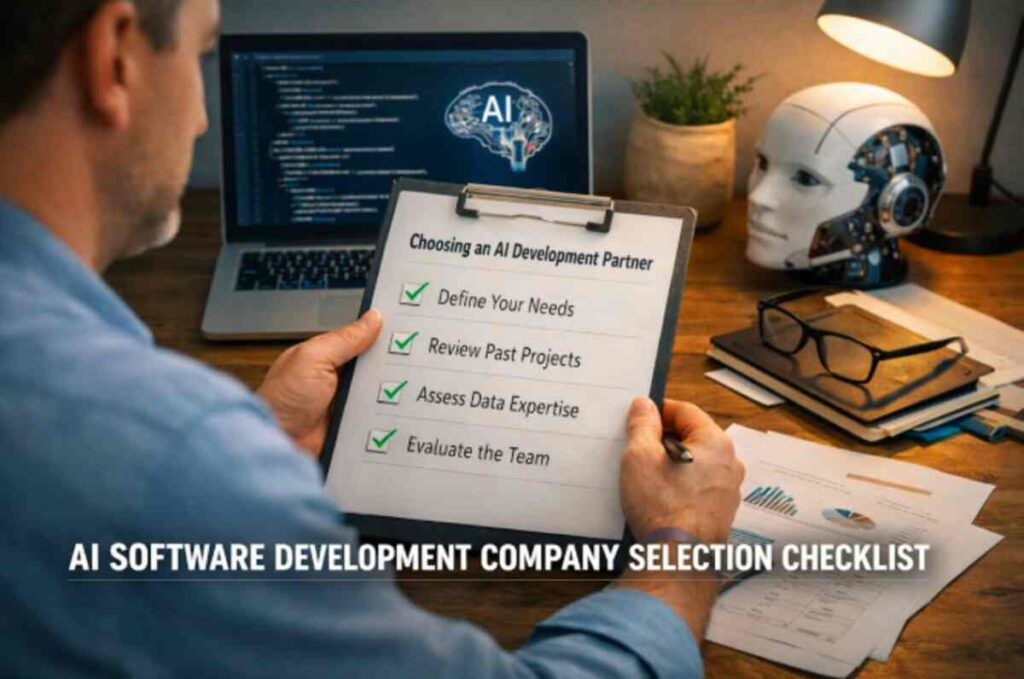
If you’re a CTO on the hunt for the right AI software development company, you’re probably swimming through pitch decks, emails, and vague promises. It’s easy to get lost in the noise. Everyone claims to be the best. Most throw around buzzwords that don’t really mean much. What you need is a grounded approach. Something real. Something that actually helps you decide who to work with and who to skip.
Let’s break this down step by step. Here’s a practical checklist to guide your decision.
1. Start With What You Actually Need
Not every AI solution fits every business. Before you look outward, take a hard look inward. What’s the problem you’re trying to solve? Is it process automation? Better analytics? Building a product feature powered by machine learning?
If you don’t know what you’re solving, you won’t know who you’re looking for.
Also, not every AI development company does everything. Some specialize in computer vision. Others focus on NLP. A few might be strong in predictive modeling for finance or retail. Be specific with your requirements. That will immediately filter out vendors who aren’t a good match.
2. Check Their Track Record
Don’t just skim their portfolio—look for depth. Have they done similar work in your industry or domain? Have they built and shipped real products, or are they more of a research-focused team?
Look for signs they’ve worked with teams like yours. That could mean:
- Projects in the same tech stack
- Familiarity with your industry’s challenges
- Experience integrating AI into existing software
Ask about failures too. A good company will own up to what didn’t work and explain how they handled it.
3. Evaluate Their Approach to Data
AI is useless without data. If a company can’t clearly explain how they handle data—collection, cleaning, processing, validation—walk away. That’s where most projects fall apart.
Do they expect you to bring a clean dataset, or will they help create one? How do they manage privacy and compliance? What tools do they use for labeling or preprocessing?
These are not small questions. A strong partner will break it down for you without hiding behind technical fluff.
4. Ask About Talent, Not Just Tools
Too many companies try to sell you on tools or platforms. Ignore that for now. Focus on the people.
Who exactly is working on your project? Where are they based? Are they employees or contractors? What’s their background?
If you’re serious about quality, you’ll want to hire AI developers who understand your tech environment and can collaborate with your internal teams. That means clear communication, code quality, documentation, and solid DevOps practices—not just a nice demo.
Look for engineers who’ve shipped production code, not just experimented with toy models. If they also have experience integrating with your existing systems, that’s a huge plus.
The decision to hire ai developers who bring practical experience rather than just academic knowledge can save you time, money, and a whole lot of headaches.
5. Test Their Communication Skills
This one’s overlooked, but it’s critical.
Even if you hire the smartest AI team on paper, the project will fail if you can’t communicate effectively. Can they explain technical decisions clearly? Do they ask the right questions? Are they transparent about roadblocks or limitations?
Set up a trial sprint or a short discovery phase. See how they communicate under pressure. Are they pushing for clarity? Are they managing timelines, or making excuses?
Bad communication kills even the best codebase.
6. Watch Out for Cookie-Cutter Solutions
A lot of firms will pitch prebuilt platforms or reusable components. That’s not necessarily bad—unless they try to shoehorn it into your business just to make the sale.
You don’t need a one-size-fits-all solution. You need a tailored system that fits into your tech stack, your workflows, and your goals.
Especially if you’re exploring AI Interview Tool options for recruiting or screening, make sure they understand the context. Prebuilt tools are great until they fail to adapt to your company’s specific hiring processes, job roles, or candidate pools.
Ask if their tools are customizable. Will they adapt them to your real-world needs, or are they handing over something that was built for someone else?
7. Look for Long-Term Thinking
AI development is not a one-off project. It needs maintenance, retraining, upgrades, monitoring, and sometimes—let’s be honest—complete rewrites.
The right partner won’t just hand off the code and disappear. They’ll help plan for:
- Ongoing support
- Infrastructure costs
- Model retraining
- Version control
- Security patches
That’s especially true if your systems rely heavily on AI and automation. These systems evolve over time. Your business changes, your users change, and your data changes. Can your vendor help you keep up?
8. Ask About DevOps and Deployment
Many AI models never make it into production. Why? Because the teams that build them don’t know how to deploy them.
Ask about their process for going from notebooks to servers. Do they handle CI/CD? Can they work with your cloud setup? What’s their rollback strategy?
They should be able to push updates, monitor performance, and handle errors in a live environment without taking your whole system down.
9. Don’t Ignore Ethics and Bias
This isn’t just about PR—it’s about risk. AI systems that make decisions (especially in hiring, finance, or healthcare) can easily go sideways.
Ask how they test for bias. What steps do they take to ensure fairness in predictions? How do they respond if a bias is found after deployment?
You don’t want to be cleaning up a mess later because someone didn’t think things through.
10. Budget Transparency Matters
The best teams will give you real numbers, not vague estimates. They’ll break down:
- Development costs
- Ongoing maintenance
- Licensing (if any)
- Infrastructure/cloud usage
- Time estimates and team size
If they hesitate to provide a clear picture, there’s a good chance you’ll face surprise costs later.
11. Check References, But Do It Right
Don’t just ask for testimonials—ask for references you can actually speak to. And when you talk to those clients, don’t just ask if the project was “successful.” Go deeper:
- Were there delays? If so, why?
- What was the quality of code like?
- How was the post-launch support?
- Would they work with them again?
People are usually honest if you ask the right way.
12. Get a Clear Exit Strategy
Things don’t always work out. What happens if you want to switch vendors mid-project? Or bring the work in-house?
Make sure your contract includes:
- Full access to code and documentation
- Rights to all datasets (if applicable)
- Clear offboarding process
- No vendor lock-in
Planning for the worst doesn’t mean you expect it—it just makes you smarter.
Wrapping It Up: Choose With Your Eyes Open
Picking an AI development company isn’t about choosing the flashiest portfolio or the cheapest quote. It’s about choosing a team that gets your problem, can work with your team, and delivers real value.
If you’re serious about building something that works—and lasts—take your time. Ask hard questions. Dig into the details. Trust your gut.
Whether you’re looking to integrate smarter features into your existing software, or evaluating an AI Interview Tool to help your hiring process, the same rules apply. Don’t just buy the tech—build the right partnership.
And when the time comes to hire ai developers, don’t settle for anyone who just talks the talk. Find the ones who can ship, support, and stick around.
There’s a lot of noise out there. But if you stay sharp, you’ll find the right team that helps you get real results from ai and automation—not just buzzwords.